Showing posts with label engagement. Show all posts

Friday, 8 June 2012

Birth, Death and Resurrection of Senior Management Engagement

At the start of the project a new Executive Pro Vice Chancellor (PVC) for Learning and Teaching had been appointed, who was the initial sponsor of the Enable project. The main role of the Executive PVC, was to chair the Senior Management Working Group (consisting of a number of senior faculty staff (Deans and/or Faculty Directors for Learning and Teaching) and a number of Directors/Heads of Services and senior colleagues. 

In addition to the start of a new PVC, the then Vice Chancellor had indicated that she would soon be retiring but had yet fixed a date.  This was subsequently confirmed as January 2011.  As a consequence, the academic years 2008/9 and 9/10 were characterised by certain amount of “planning blight” and senior managers being (understandably) cautious in the face of impending change.

Not only did the executive start the project in some state of organisational churn, so did the department the Enable team were working from. The Learning Development & Innovation (LDI) team had recently been moved (following an external review) from the University’s Information Service to the Academic Development Institute (led by the Director of Academic Development).

After the first four months of the project the Academic Development Institute was abolished and the LDI team (including all Enable project staff) became a standalone team reporting to the Executive PVC.   During this period, senior management engagement with the project was good .  There was also considerable engagement from staff involved in the various change initiatives across the University, and from award leaders, programme managers and Faculty business staff and quality administrators.

About 18 months into the project, the Executive PVC left the University (and was not replaced for about a year). Following a fairly lengthy hiatus during which it was unclear (even to the Head of LDI) who the LDI team reported to, it was agreed that the team and the Enable project should report to the Deputy Vice Chancellor through the Director of Academic Policy and Development.   Senior management engagement had waned somewhat during the “hiatus” (but “spoke” engagement had remained good), however the Deputy Vice Chancellor became very receptive to the ideas on managing change and sustaining innovation being promoted by Enable, and a good period of senior management engagement ensued.  However, this period also coincided with the “last days” of the previous Vice Chancellor and the selection and arrival of the new Vice Chancellor, who took up leadership of the University in January 2011. As a result, although engagement with Enable’s ideals was good, translation of this engagement into action was very difficult.  However, this period also saw the opportunity – seized by the Enable team – to initiate the “FLAG” work of Enable on the back of a number of Senior Leadership Team initiatives instigated by the new Vice Chancellor.

In June 2011, a new Executive PVC arrived at the University.  At this point, oversight of the LDI team moved into the new PVC’s purview although the Head of LDI continued to report to the Director of Academic Policy and Development who had similarly moved reporting lines.  This move created another “disjoint” in senior management engagement as the new PVC obviously had a great many things to take on board and to plan.  

By the end of the project, 7 of the 17 people who attended the first SMWG meeting had left the University, including the Executive PVC. Nevertheless engagement was subsequently renewed and the Executive team has now picked up messages  sent by Enable including the concept of ‘joined up thinking’, and the development of a Change Management role.  This renewed interest was due to the project team able to present a clear message of Enable to the executive thanks to previous experience with communicating with the executive team, along side this the project team were able to use senior management champions to pass the message of Enable on to the executive.

Despite the considerable “organizational churn” evidenced above, a constant and stable factor throughout has been a recognised institutional need to ensure curriculum development is responsive to demand.   This included ensuring that policies, processes, and supporting technologies for curriculum/product development were designed in a way that was responsive to the needs of both faculties and learners.   This required flexible management of the existing portfolio including the process for creating new product, along with guidelines and workflows to encourage a culture of innovation. 

Wednesday, 28 September 2011

New Course Product Design

As Enable moves towards its final phase we are making some great progress with the work we have been doing for the FLAG project and for supporting the work around developing unified course development theory!

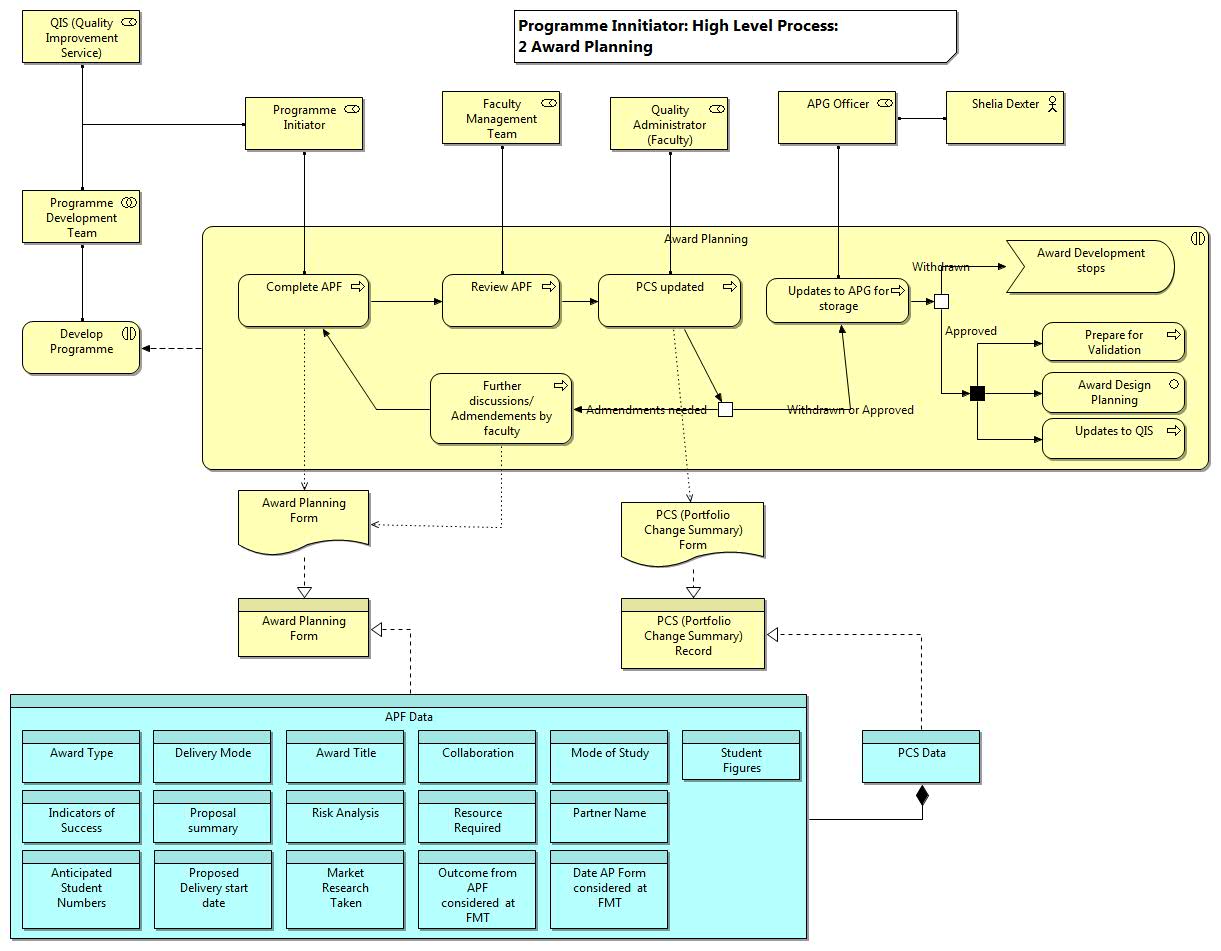
We have created a number of ArchiMate business layer views from a model of CDD. This has been based on the baseline Sam did for the project, but as we knew the processes had changed since then thanks to the Quality Review work we also needed to read a lot of documentation and have discussions with stakeholders involved within faculties (Directors of Teaching and Learning, Tutors and administrative staff) and services (such as Quality and Partnerships).
ArchiMate Model of Stage 2 - Award Planning (high level)
During the stakeholder discussions with the views we noted a few interesting factors:
  • What is believed to happen by managers often isn't the case for those on the ground
  • Processes that are believed to be sequential are often running in tandem to ensure speed in development (can cause problems)
  • Responsibility of the process of new product development can sit with different individuals without any joining up.
Although the model and its views have been useful for my own purposes, and for discussions with stakeholders they were not quite at the right level to be used with the Pineapple software, which worked at a lower, business process/ work flow level. With the ArchiMate views  it was hard to create links between different stages and the support resources available to the University and highlighting the different preparation points within the processes. At this point it was clear a work flow was needed to pull out all the information from stakeholders around the advice and guidance needed to complete the course development processes.

The first attempt at creating a work-flow from idea to validation is shown below - all information in black is considered part of the core/ parent process, the text in red is information that sits within child processes (Completing documentation, Understanding Employer Engagement, Assessment etc). 

This helped clarify my thoughts before moving on to using Word as a standard tool to create the workflows, with the relevant advice attached to the different preparation points. At first each point in the core work-flow became a new stage in the process, however we soon changed that to match the stages from modelling.
  • Idea 
  • Initial Approval 
  • Award Approval Documentation 
  • Preparing for Validation 
  • Validation 
 An example work-flow at this point, including questions to ask at each preparation point:
Flow and Advice v1 for Stage 3 - Preparing for Validation

These models have since been distributed to the project team to help create the child processes, as they are more familiar with that area. This was one of the reasons I chose to use Word to create the flows, so that they could copy the standardisations easily. Even so it has required a short demo document so that the flow fits the set up of Pineapple, including a two page document where on one side was the actual flow in Pineapple using screen shots and on the other was the actual flow created. As I am very close to this work it has been invaluable to hand it over to the project team for review and also over to faculties already interviewed. It has also been vital that I keep impartial to the work so that I can view all aspects of the suggestions made. I also believe it has helped that I am not a process owner in creating these flows. It has been demonstrated by some of the work already gone on that process owners have a very narrow view of curriculum design and development!

These workflows have been designed to be printed out and used for each stakeholder discussion to ensure we captured each faculties nuances around course development before building the process into Pineapple.

Tuesday, 16 August 2011

Models to flows to Information, Advice and Guidance

As mentioned in 'Flying Forward' the Enable team, and others in the department, have been working on creating a ToolBox (known internally as the FLAG project) for supporting curriculum design and development for those roles involved in the process.The project team started with the original baseline models and then modified them based on the existing information available on the websites, once a 'trail' process was in place interviews took place with Teaching & Learning Directors, faculty quality staff, and the Director of Quality Improvement.


The first thing we learnt with using the model from the original baseline was that the 'viewpoints' hadn't been fully considered, and were therefore either too detailed or included too many different roles. Therefore the team went back and created models from the viewpoint of the person who had come up with the new course idea.
Example: Stripped down ArchiMate view used for discussions

This then raised a number of issues with complexity of the processes, and how the main process of 'Create a new Course' consisted of different, lower level processes, and what course initiators and designers needed to consider as opposed to a module designer. The main process was broken down to different processes, and as such different views:
  • Approving the idea in Faculty,
  • Approving the idea in the institution,
  • Developing the Idea,
  • Preparing for Validation
To keep it simple we needed the 'parent' process (Create a New Course) to go into Pineapple and become the backbone of FLAG (creating a work-flow that would be developed around the 4 sub processes above).  This backbone would then allow the stakeholder engaged in CDD to move to 'child' work-flows whenever needed (we would consider developing partners a child process of getting the idea approved in Faculty).

Stakeholders happy with the high level process of CDD could then directly move to specific child process they could be struggling with (How do I set up an international partner? What can I do differently around assessment? etc).
This was great in theory,  however it was noted that there was no clear way to link process within Pineapple. Thankfully the Plymouth team were contacted before we started this project and have been very supportive in developing Pineapple to support processes beyond the original intention of APEL. After putting together a specification document for this change they are now working on making this possible.

UPDATE: 
2012/07 It is now possible to create parent, child and grandparent relationships between processes within Pineapple. 
Enable had already noted that the course development process was under review, and that faculties have their different ways of doing their side of the development process. The creation of the 'trail' process within Pineapple has helped us identify a baseline for faculties and the Quality Improvement Service to discuss and view issues/ holes already highlighted. It helped those engaged in the process see how the tool would be used, identify differences in their processes & best practice, and inform us of any useful information/advice/ guidance (IAG) that they provide to members of staff for the different steps.

UPDATE:
2012/07 The review of course development processes is almost complete, and discussions with business owners means that FLAG will soon be handed over to our Quality team. The new process is already partly in FLAG and once approved the Quality team will make it live to users.  

Monday, 4 April 2011

Dripping Tap

Over the last two years(!) we have been constantly sending out messages at all levels of the university, regarding managing:
  • our projects using a Change Management Office Approach (i.e. P3M3)
  • our information
Methods we have used included:
  • One to one meetings- with a focus on faculty/service needs
    • with senior staff
    • with project managers
  • raised at committee meetings
    • informally with a focus on issues raised in committees
    • presentations raising issues that have been raised during one to one meetings and how they link to points above
  • Summary documents and articles
After hitting a number of issues with getting these messages across including:
  • Loss of executive staff
  • Loss of engagement when making presentations
    • Using wrong language
    • Not using relevant examples
    • no real examples of what success looks like
  • Starting new initiatives without full stakeholder engagement
  • Limited communication by projects outside of committees
We have now found that the message has sunk in at all levels, so would like to say to all our colleagues trying this to hang in there! We now get to hear the same message being said back to us during committees, and have got the new senior executive sponsor fully engaged with the project. After a few false starts initiatives are starting to be run with stakeholder engagement, communication across the university is growing (including the development of an online change service - more on that later). We are starting to look at projects from a central perspective and understanding that changes to one area of business impacts can impact other areas. So it's all good here at Enable.

Friday, 16 April 2010

Taking a step back

I have been to two very different, and interesting, conferences over the last two weeks. The first was in Plymouth, a general elearning conference covering schools, FE and HE (http://www2.plymouth.ac.uk/e-learning/). This was a packed two day event and it was difficult to see everything, however those sessions I attended were very good. The keynote speech by Josie Fraser discussed the web and privacy, the one by Dave White discussed how do we support what learners need and balance that against what they want, and has some interesting blogs on the subject (http://tallblog.conted.ox.ac.uk/index.php/author/whited/).

I also did a presentation at the conference to a slightly smaller audience around supporting innovative curriculum in a traditional HE environment. This was a trail for Florida in June and was very successful, the discussions lasting 30mins after the presentation. There is a clearly recognised need by institutions to take a step back and look at what they are doing and why, without the caveat “we’ve always done it this way”. It was also acknowledged that some of the big barriers to institutional change that takes time and effort is engaging support from senior management, and getting them to understand that often quick wins are quick draws reinforcing the quid pro quo. The leaflet that went with my presentation is available from the project website (http://www.projects.staffs.ac.uk/enable/p3m3.html) although the slides are also available on the same page, my talk was slightly different to the one recorded. It is a shame I forgot to record the new presentation as some interesting points were raised.

The second conference was the JISC annual conference in London (http://www.jisc.ac.uk/events/2010/04/jisc10.aspx). This one day event was also jam packed with good information. Martin Bean (VC Open University) did a great keynote to open the conference and I attended two useful sessions that support the work of Enable, including presenting our poster to the community.

Friday, 26 February 2010

Dissemination and promotion

The project has being focused on producing a Project Initiation Document to support the work it is doing around modelling course related information within CDD (Course Design and Development). It has also started working towards creating the “to be” view of CDD. The team has pulled out all the interview notes from different faculties about issues around CDD and also a list of issues from its interviews with the staff involved in the different initiatives at the university. I will be recording our next stage with some photos as we try and group together all the different suggestions and issues we have collated using post it notes.

Along with the work Sam has been leading we have also been meeting with deans in each Faculty to talk about their plans for the next year and to keep them up to date with the progress of the Enable project. This has been very useful and Mark will be writing up a summary sheet of our conversations, and about some of the issues that the deans see as needing to be addressed in CDD.

We have also been supporting the SURF Review, although we were unable to attend one of the meetings we have been able to pass on the issues highlighted by the project partners. There was some interesting discussions during this meeting between perception of progress from colleges, the university, and employers. Enable is supporting this work and has provided a lot of information from the partners experiences based not just on the annual report but on the spreadsheets we ask them to complete during the design and development process of a new idea.

Seeing as I called this a dissemination and promotion post I better say a bit about the dissemination we are planning to do outside of the university. We have had our abstract approved for the  Plymouth e-Learning Conference which is in April, and we are also presenting with the rest of our programme at the next JISC eLearning experts meeting in Birmingham in March, and the JISC Conference 2010 in London in April.

Friday, 5 February 2010

Measuring the costs and benefits

The project is working hard at planning for managing course information with regards to the work of the Quality Review Process. As part of this I have been reviewing and attempting to write scenarios based on some of the issues around the Quality Review. This has been much harder than I expected using TOGAF and required me to look at a number of samples online to help me. This will not be a quick solution, however there is real value in doing this, and I am considering writing one for Enable itself. This could be a very useful communication tool to use with the executive. This is important as I try and get them to understand the benefits to an Enterprise Programme Office and how it will save money for the university. It seems as though the message is being lost somewhere at the moment. As part of this is the issue around the SMWG and the fact that it hasn't been able to meet recently. There was one scheduled for today but this has been cancelled, although the project team is meeting with the executive sponsor for the project and the Business Re-Engineering Manager for the university.

We have had some interesting interviews and informal conversations this week around managing course information, one discussion was focused on how accessibility could be embedded into course design rather than bolted on as part of induction or ignored completely. This was an interesting point, and one that was particular to that stakeholder, which reflects back to last weeks workshop about different views by different people.

We have also met with one of the faculties to talk to them about issues they have with CDD, and with the Quality Review team. This meeting was valuable in that it gave us a real insight in how to market content to the executive, but also about what the executive expect from projects running under their view. We are now writing a mini PID for this so we can communicate some of the outputs of the work we are doing and how it all fits together to create a bigger plan for the university whilst still giving them some quick wins

Friday, 29 January 2010

Managing Change and Innovation

Flexible Service Delivery Event

This week has been a busy one, we spent the first two days down in London with the Flexible Service Delivery programme, the first day was catching up with projects and talking about the use of SOA, and other solutions to managing data.
The second was focused on modelling and using Enterprise Architecture. This was very useful for us, and in particular for me, as it highlighted a number of issues around governance and process ownership that is needed for the modelling to be successful. It was also interesting to see during the modelling exercise that everyone had their own perspectives to a similar process, depending on their experiences and knowledge.

UPDATE: Since this blog we have used ArchiMate and Enterprise Architecture extensively to support the work of Enable (see Enable: Using Archimate in the Enable Project), and have pushed the benefits of the approach to other projects including XCRi, Student Systems, Assessment and Feedback, and Partnerships. This approach is slowly being appreciated by all levels of management at Staffordshire University.
 
I have had my paper successfully accepted to the 8th International Conference on Education and Information Systems, Technologies and Applications: EISTA 2010, held in Florida in June – this is based on my document I wrote a while ago for the Senior Management Working Group on Programme Management, to fit with the presentation I gave them last year. I’m pretty excited about this, and looking forward to discussing the theories etc. As part of this I have submitted something similar for the Plymouth conference as a trial. It’s the first time for me presenting all on my own!

UPDATE: Read my experiences here about the EISTA conference, to read the paper I did please check out. The paper is now available "Corfield, FM, (2010) 'Supporting an Innovative Curriculum in a Traditional HE Environment. Developing a winning strategy to support change at Staffordshire University', Journal of Education, Informatics, and Cybernetics, Vol 2, No 3, 2010".

As I am becoming more and more focused on Portfolio Management /TOGAF it is clear that support from the whole of executive, along with clear governance and business strategy statements are needed. How ready are we for all this? At the moment I would have to say not very, however with the work of the project and by constant communication with staff, this will change over the next year.

Friday, 22 January 2010

Using TOGAF

This week has been a planning week, with looking at the issues raised, and putting a plan of recommendations together for the SMWG. This document is designed to support how the programme office will work, and the work we are doing with EA and TOGAF.

As part of the work of Enable we are now talking to our Quality office around how they see the information used to support curriculum design being better utilised. This has had us discussing the issues found during the Quality Review (as well as those from interviews with Enable) and some ideal solutions to these issues using supporting technology. We will be following TOGAF for this information and are using our initial meetings to complete the “vision” stage. Sam is using the TOGAF guidelines to create scenarios from these meetings as part of it.

Next week is a heavy one from the perspective of EA as both Sam and I will be attending the next FSD meeting in London which is followed by an EA day. We then have an Architecture Elluminate session scheduled for the Wednesday afternoon. All EA hands on deck! I have installed BizzDesign on my little laptop which could also be quite interesting!

Friday, 15 January 2010

More snow time

As mentioned in my last blog the SMWG was supposed to be this week, however snow once again fell from the skies making it impossible to run, therefore it has been rescheduled for February. This is useful as there is now further discussion occurring at Executive level around the development of a programme office. We are waiting to hear what happens with those discussions and how they impact on the programme office governance and ideas we have already worked on in Enable. As part of the work we are doing for a programme office we are organising individual faculty meetings with Deans, heads of service, and FAD's as part dissemination about Enable and part discussion about their individual initiatives that could impact on the university, in the arena of CDD. This will then lead to meetings with those leading the initiatives to find out more about the work they are doing.
This leads on from last years interviews with internal projects and the issues mentioned in the last blog, along with these we have also managed to have most of the meetings with award leaders, finding out their experiences of validation, annual review and the 5 year review. We have had some interesting discussions about what would make these experiences easier and more responsive, and in one case had a good open discussion about the culture of lecturers and attitudes to senior/ executive management. These have been noted down to discuss at the next Enable team meeting.
Next week we have more internal Enable meetings, and we will also be talking with CETIS. Sam is also helping me with my first adventure into using BizzDesign Architect, could be interesting.
By now I was hoping to know whether a paper I have written on the development of a programme office in supporting a change in CDD had been accepted in the US but nothing has been said yet. I will let you know as soon as I do.

Tuesday, 15 December 2009

Merry Christmas

Well this will be the last blog before the Christmas break, so Merry Christmas & Happy New Year from me to you. This week has been mainly working on the interim report, adding more detail to the outcomes we have had so far and adding useful information from the report to the website so others can see information about the project, this includes the issues raised from the first year of the project, and the development of the programme office. I have also changed the tone of the report based on the knowledge that it will be published online for all to see.

At the team meeting this week we have continued discussion on the governance of the programme office that will be raised next week with the Pro Vice Chancellor, along with what to name the office. I'm tempted towards "Enterprise Programme Office" as it is across the enterprise and seems to be an accepted term in business, however there has been some discussion about the fact that "Enterprise" has a different meaning in HE and that it should be called something generic such as "University Programme Office". We will have to see what our Executive think. It is an interesting idea that we should be changing what is a recognised term to something that fits the language of the HE environment even while saying that we need to change our language to fit that of employers to assist in employer engagement in award development.

We have also been discussing our modelling work, we need to get a head with this over the next couple of months as it will be vital to have a "To Be" model to support the programme office and also to support the work we need to create useful models within the pedagogic planner Phoebe. I have also submitted my first paper to an international conference, relating to embedding EA and Programme Management into an institution. I am keeping my fingers crossed!

Our project partners are working hard at the moment creating their first snapshot report based on the work they have been doing for Enable. I have already received one draft - thanks guys - which was interesting reading. I am looking forward to the others arriving before the next SMWG meeting so that the findings can be covered in the meeting.

Friday, 11 December 2009

Flexible Service Delivery

It has been a busy week, I have been writing a paper for a conference next year on developing an Enterprise Programme Office and using Enterprise Architecture. This has coincided with the FSD JISC meeting down in London and discussions with our Finance Director. All of which have helped with giving me clear ideas of how we should be working as a university, and how to communicate the work both internally and externally to the project.

The discussion with the Finance Director lead to “imagine if..” statements which give basis to the “To Be” model that we need to build into our modelling. I need to capture these for sharing with the project team. A number of our “imagine if” scenarios relate to the work done by the FSD programme. The workshop I attended was on behalf of Sam, but in fact, I can see a real benefit to attending these events as a project manager, as well as those with a more technical leaning. There was a lot of useful discussion about enabling institutions to talk to vendors with one voice, and enabling institutions to be clear about their requirements by using Enterpise Architecture. Although EA isn't the be all and end all it is certainly a useful framework that can be used to help FSD and has helped the Enable project, and the institution, including giving us structure to collating evidence of behaviour within the university. It has also helped us identify the need for an Enterprise Programme Office that fits with the existing Executive Programme Office that already exists.

Here is a useful blog from the session by John Townsend (Liverpool John Moore) who was part of the last afternoon session group I participated in around effective change as part of the FSD business case. He reflects on the the idea of a Programme Office, and the need for effective governance. The governance put in place by Enable has been very useful in effecting change with the use of the SMWG but we need to be clear that the governance needs to go further to support our Enterprise Programme Office.

Tuesday, 3 November 2009

Useful Reading

Well the last few hours have given me some interesting reading thanks to Twitter, in particular @mikehamlyn and @theopengroup. The first article was from the Guardian and talks about "treat students more like customers and become more responsive to the needs of businesses" and about exposing more information to the learners and to businesses "The food-labelling style system to tag each course is designed to give students more information, which has widely been interpreted as preparation for raising tuition fees." This links to Enable, and helps us keep our focus on course information and how it will be used and who the audience is, if the audience is the learner we need to ensure that information is not hidden under a difficult language as discussed in an earlier blog.

The second bit of interesting reading was from Tom Graves' blog, about his experiences at the TOGAF Conference in Hong Kong. This blog entry relates Toms experiences, showing "... the unique Chinese perspective on what has historically been a somewhat Anglo and technology-driven construct". He notes that the first speaker was interesting due to "an almost complete absence of any reference to IT – instead almost all about management and business-architecture" and the balance between Western best practice and national principals, he also notes that speakers talk about the long term, and balance. Both the article and the blog entry are, in my opinion, well worth a read.

Tuesday, 27 October 2009

Partnership Meetings

I attended a recent SURF meeting at Staffordshire University that discusses the development of Fd's. This was a very informative meeting, as issues raised were clearly linked to work being under taken by Enable. The main conversations were around a new review of products for our partnerships which Enable will be assisting in, UCAS course data and issues with systems.
The group discussed UCAS course data and how it is handled between colleges and the university, and who should be supplying the information to UCAS. This is something that had not been discussed with Enable, but as we start looking at course information it is an important part to consider, and if the process changes, or should each college be handled the same way?
As part of the discussions around system issues from this meeting we had a get together with a member of staff from faculty to talk about their experiences of using university systems to support non traditional courses. This was an interesting discussion that showed that sometimes we, as a university, move faster than our learners, and that some processes need to be more flexible with the ability to support non-technical approaches, including e-enrolment, and that we should be encouraging the use of plain English for anything learners are involved in rather than assuming a level of literacy that they may not have not just for handbooks but also for the their online experiences. At the same time as this the partner colleges also reported issues with assumed learner access to technology, which can impact on learners being able to access systems once they attend lectures. Hopefully with the input of partner colleges we will be able to resolve this and other issues. Which links nicely to our next stage of the project which is where we look at issues raised and how they can be addressed and piloting some changes.

Friday, 16 October 2009

Programme Meeting in Manchester

Well it was an interesting two days in Manchester, I found them very useful, although often the session discussions did not have clear guidance the discussions we had during them were very useful. Participants used twitter to make general notes as the sessions went on and it's now time to go through them and weed out the useful points that need to be remembered. The main theme for the sessions I attended were around initiation and planning processes. We discussed how programmes are initiated can have an impact on the processes and how we have both supply and demand driven initiation processes. I really like the work being done by ViewPoint and could see their software being adaptable to the early initiation phase to help staff consider why an award is being developed with prompts to think about innovation, engagement, and rationalisation etc.
We discussed the fact that employers attend validation when involved in an award but do they attend annual monitoring, and should learners also be able to attend reviews on awards? We also discussed whether reviews should be annual but triggered by certain events - and what would they be and how would they occur. How do we value content from processes? We need to be able to look at time inovled, re-use of content created and what the outputs are.
This is just a sample of the thoughts raised at the event, so as you can see some interesting discussions took place, its just being able to clarify them for the project and how many can be considered/ actioned within the project. Especially considering this was just one of the themes from the event.

Tuesday, 18 August 2009

Planning ahead

With the summer holidays nearly over normal blogging service will be resumed in September. However we have not been quiet in the time available to us and work has been progressing on a number of different levels.

We have completed the document I mentioned in the last blog about how Enable has been working with the Executive Programme office, this has lead to us working even closer with them in creating a university wide plan for four areas:

  • "Award Portfolio"
  • Curriculum Development and Course Information
  • Curriculum
  • Learning and Teaching

This plan will be the  basis of moving forward, the first iteration of the plan (covering the top two areas) will be submitted to Gill Howland in the next few weeks but before it can be completed we need to meet with the Programme Executive office to go through initiatives which cover the first two areas mentioned above.

Some of the things we are preparing for at the moment is ALT-C at the start of September and the Cluster Meeting in the middle of the month.

Wednesday, 22 July 2009

Enable keeps spinning

As mentioned in the last June blog, this month has been fairly quiet due to Summer Holidays, which will be continuing over August too. Still things have been happening in the world of Enable.

At the start of July we had an interesting meeting with the Student Union with regards to using their members to help spokes engage with learners, they are very interested in supporting Enable and engaging learners in the process of curriculum design and development more than they have been recently. This is really positive news that will be passed on to the spokes.

Straight after the Student Union meeting we met with a possible new Spoke around the subject of supporting learners through APEL to make it quicker, and more efficient that the existing process. This is a new idea that has been submitted to JISC for funding, although the Project Initiation Manager is hoping that the project will go ahead regardless, as there is a real benefit to the university if it goes ahead. Whilst in this meeting we got some feedback about the usefulness of Enable, where the Project Initiation Manager was very positive, calling us Critical Friends for the project and useful for bouncing ideas off and getting a different view point than thinking about their particular area. This is very good news!

We have also spoken to Paul in the executive office about Programme Management at the university, and managing change. We are going to put together a document for the Executive to cover the work Enable is doing and the work that the Executive Office are doing around this area and how we are working together.

We have now finished the Investigation phase and now in the refinement phase as part of which I am doing some work for the next SMWG meeting, to include a general list of issues around CDD and around change management that can be discussed and prioritised. We are also doing a second round of interviews, including a closing interview with DIVAS.

Tuesday, 7 July 2009

The Learner Experience

Last week I attended a focus group looking at the learner experience for the distance learner from point of induction onwards, I spent a lot of the time listening to the experiences of staff around the table dealing with learners different needs and thinking about how the learner experience can be made better during the curriculum design and development phase. A number of issues appeared to be linked to this area including providing materials for study (could be reading lists, amazon shopping lists, or posting resources) costing models for awards (including how study materials are costed into course costs, should they be fixed for period of study, how clear are costs communicated to learners, is this included in validation documentation?) and what online tools should be included to support distance learning - and getting the learners to understand what skills they will need when enrolling on a distance learning course. These last two points need to be considered at design stage, what is good practice (for example photos of staff online, managing expectations with online communication etc) to promote the relationship between tutor and learner. I will be keeping an eye on this work for Enable, and will be using its outputs to feed into any work we are doing.

It seems that once these focus groups are completed with staff there will be a number engaging learners after September, I have mentioned the workshop I participated in with JISC (mentioned in my last blog) and how that could be helpful with the learner experience, in particular the diary room approach could give a good idea of the learner experience changes in the time they spend studying with Staffordshire University.

Monday, 18 May 2009

Capturing Perceptions

Last week was very busy, and this week will continue in that theme. We had a partner visit and tt was the programme meeting in Birmingham. This was followed by a presentation on Strategy and leadership for my course, which I started to support the work of Enable.
 UPDATE: 
This presentation has since been used at EISTA 2010 and published in Journal of Education, Informatics, and Cybernetics, Vol 2, No 3, 2010. 
This course has since been completed and I have now started an MSc in Innovation and Managing Change in Higher Education by Negotiated Learning. I have finished my first module for this but will be putting the award on hold while I go on maternity leave. 

This week I am doing a fair bit of training The main aspect is looking at TOGAF and ArchiMate with CETIS in Bolton tomorrow. 
UPDATE: 
Blog available on this day here: Enable: Where angels fear to tread 

I am also doing some mentoring/coaching as part of the next stage of my course, this work focuses on supporting another member of staff working on a large scale project. In between these days I am still looking at evaluation and capturing perceptions of stakeholders, and at the structure of a project team event for the end of June.

Perception Questionnaires

I have been given a very useful questionnaire from Cardiff University that originated at BAE on finding out what people want from a project, and then measuring how successful we have been in providing it in the future. The questionnaire has been adapted from BAE and to asks the project lead (or stakeholders in the project) the following:
  • List 5 achievements for the project
  • For each of the 5 achievements score them 10 (Most Important) - 1 (Least Important)
  • For each of the 5 achievements score them 4 (Delighted with how it works at the moment) to 1 (Very Dissatisfied with how it works at the moment).
Each score was asked for twice, the initiative and for Enable. The project lead (or stakeholder) is then asked for what they consider the 'Big One' (i.e. high need but very dissatisfied with at the moment) and the 'Pat on the Back' (i.e. high need but delighted with at the moment).

This has gone out to our project partners via the VSN. I also found a useful questionnaire online "The Organisation Perception Questionnaire" although this relies on rating some statements, so the team needs to think about what needs to go in there.

UPDATE:
The Organisation Perception questionnaire has not been used by Enable, however the BAE questionnaire was used (as adapted above) during the first stage of the Enable project and was found to be extremely useful when revisiting expectations against the reality and being able to capture what was/not achieved and why. It was used in conjunction with a semi-structured interview technique and a Project Overview document to support the Enable team in understanding the outputs expected from each initiative, what outcomes could be expected, and what overlaps might exist with other initiatives running in the University at the same time. This work all fitted with the Programme/Change Management approach adapted by the project team. Further information on evaluation techniques used by the Enable team will be available in August 2012,  through the Evaluation Story & Final Story written for JISC

Partner Engagement

Partner engagement has really picked up after visits have been completed at the partner sites, we are seeing blogging from tutors in Shrewsbury college on the VSN. Hopefully more blogs and discussions will grow in the next few months with the support of college coordinators such as Emma, Richard and Gerard. I will be sending out a reminder email to them all towards the end of the week to ensure that they are all happy with what is happening at their colleges.

UPDATE:
A blog post has been written to cover partner engagement from the perspective of the Enable project team.

Programme Meeting


The Programme meeting in Birmingham had a few useful sessions, although in some cases information was appearing at the wrong level for some project managers. I certainly found the networking activities/ directed discussions very useful although the form filling in the afternoon was probably less informative. One session focused on understanding your organisational type as part of Change Management/ Engagement Strategies. When we looked at the type of organisation we felt Staffordshire University was we were surprised to see such a strong leaning to Innovative Culture, however we felt that we needed a balance across some of the other cultures, in particular Business. There was some interesting engagement methods used by some of the presenting projects that I would like to consider for projects at the university, including posters in hallways for commenting on with post-its and workshops that included stakeholders to look at how they see failure rather than success! There was still not enough "here is how we did it" - in particular the change academy model was used by a project - what is this and how did they modify it and why? It looks like some investigation on their website as it was not easy to find on the HEA site.

Friday, 5 December 2008

Faculty and Process Spokes - Feedback

UPDATED 2012-06

We have had another busy week here, talking to members of faculties, those reviewing processes in the University, and taking part in Annual Award Reviews. It all feeds into what we would like from Curriculum Design and Development.

An issue highlighted from interviews recently was around using templates for faculties in course design. There are a number of different course design templates that need completing, and even when training is provided they can still be interpreted and completed in a number of different ways.

UPDATE: By creating FLAG we are hoping some of these issues will be taken out of the equation, although we are still waiting for feedback on this, and there are some rather big changes expected in the near future around forms faculties will need to complete, these will be reflected in FLAG.
There are also some new spoke initiatives, Document Management, that will support how information is collected within a workflow. XCRI-CAP which is looking at what information is stored, how it is stored and inputted into existing systems. XCRI-CAP will be looking at creating a single source of truth of course information and therefore will be looking at the quality of information collected. The Student Systems Project is also looking at course information, and is working in tandem with the XCRI-CAP project team.

When asked for "blue sky" ideas we heard about:
  •  personalised prospectus and website.
UPDATE: With the new XCRI-CAP project being run by Sam Scott this 'blue sky' thought is becoming closer to being a reality. Importantly Sam is working closely with the Enable team to understand the impact of her work, alongside that of other initiatives within the institution. In particular Sam is working on using ArchiMate models to communicate how this can happen and what can cause issues.
  • experiences should be personal to those we are trying to engage
UPDATE: This fits with the new University Strategy and the Academic Plan, including focusing on graduate attributes. However at this time this hasn't been clarified completely, how are we going to do it? FLAG has been designed to ask the questions of course designers and gives some guidance on opportunities for personalisation of course delivery, however systems and information in the university still make this very difficult.
  • and that the addition of negotiated modules onto traditional awards as options would be useful.
UPDATE: Recent restructuring of awards may make it possible in the future. Although there has been no mention of this particular goal in university documents, it does fit with personalisation of award delivery and design.

I have yet to have time to blog about last weeks training and conference work, but I am hoping I will get some time free soon to do that! Next week we have more interviews and we will be presenting to our first college partner HE Forum.