Showing posts with label Process Mapping. Show all posts

Wednesday, 28 September 2011

New Course Product Design

As Enable moves towards its final phase we are making some great progress with the work we have been doing for the FLAG project and for supporting the work around developing unified course development theory!

We have created a number of ArchiMate business layer views from a model of CDD. This has been based on the baseline Sam did for the project, but as we knew the processes had changed since then thanks to the Quality Review work we also needed to read a lot of documentation and have discussions with stakeholders involved within faculties (Directors of Teaching and Learning, Tutors and administrative staff) and services (such as Quality and Partnerships).
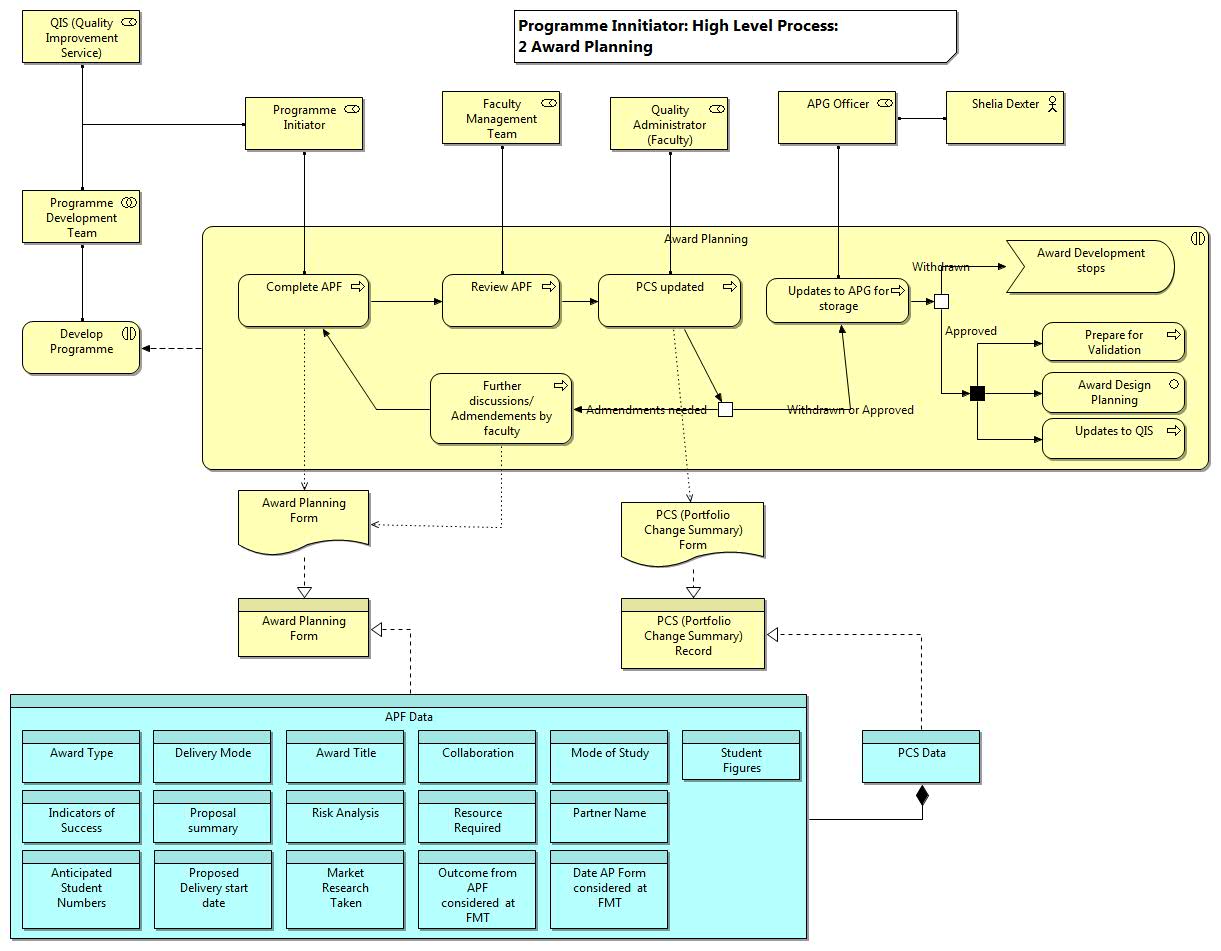
ArchiMate Model of Stage 2 - Award Planning (high level)
During the stakeholder discussions with the views we noted a few interesting factors:
  • What is believed to happen by managers often isn't the case for those on the ground
  • Processes that are believed to be sequential are often running in tandem to ensure speed in development (can cause problems)
  • Responsibility of the process of new product development can sit with different individuals without any joining up.
Although the model and its views have been useful for my own purposes, and for discussions with stakeholders they were not quite at the right level to be used with the Pineapple software, which worked at a lower, business process/ work flow level. With the ArchiMate views  it was hard to create links between different stages and the support resources available to the University and highlighting the different preparation points within the processes. At this point it was clear a work flow was needed to pull out all the information from stakeholders around the advice and guidance needed to complete the course development processes.

The first attempt at creating a work-flow from idea to validation is shown below - all information in black is considered part of the core/ parent process, the text in red is information that sits within child processes (Completing documentation, Understanding Employer Engagement, Assessment etc). 

This helped clarify my thoughts before moving on to using Word as a standard tool to create the workflows, with the relevant advice attached to the different preparation points. At first each point in the core work-flow became a new stage in the process, however we soon changed that to match the stages from modelling.
  • Idea 
  • Initial Approval 
  • Award Approval Documentation 
  • Preparing for Validation 
  • Validation 
 An example work-flow at this point, including questions to ask at each preparation point:
Flow and Advice v1 for Stage 3 - Preparing for Validation

These models have since been distributed to the project team to help create the child processes, as they are more familiar with that area. This was one of the reasons I chose to use Word to create the flows, so that they could copy the standardisations easily. Even so it has required a short demo document so that the flow fits the set up of Pineapple, including a two page document where on one side was the actual flow in Pineapple using screen shots and on the other was the actual flow created. As I am very close to this work it has been invaluable to hand it over to the project team for review and also over to faculties already interviewed. It has also been vital that I keep impartial to the work so that I can view all aspects of the suggestions made. I also believe it has helped that I am not a process owner in creating these flows. It has been demonstrated by some of the work already gone on that process owners have a very narrow view of curriculum design and development!

These workflows have been designed to be printed out and used for each stakeholder discussion to ensure we captured each faculties nuances around course development before building the process into Pineapple.

Tuesday, 16 August 2011

Models to flows to Information, Advice and Guidance

As mentioned in 'Flying Forward' the Enable team, and others in the department, have been working on creating a ToolBox (known internally as the FLAG project) for supporting curriculum design and development for those roles involved in the process.The project team started with the original baseline models and then modified them based on the existing information available on the websites, once a 'trail' process was in place interviews took place with Teaching & Learning Directors, faculty quality staff, and the Director of Quality Improvement.


The first thing we learnt with using the model from the original baseline was that the 'viewpoints' hadn't been fully considered, and were therefore either too detailed or included too many different roles. Therefore the team went back and created models from the viewpoint of the person who had come up with the new course idea.
Example: Stripped down ArchiMate view used for discussions

This then raised a number of issues with complexity of the processes, and how the main process of 'Create a new Course' consisted of different, lower level processes, and what course initiators and designers needed to consider as opposed to a module designer. The main process was broken down to different processes, and as such different views:
  • Approving the idea in Faculty,
  • Approving the idea in the institution,
  • Developing the Idea,
  • Preparing for Validation
To keep it simple we needed the 'parent' process (Create a New Course) to go into Pineapple and become the backbone of FLAG (creating a work-flow that would be developed around the 4 sub processes above).  This backbone would then allow the stakeholder engaged in CDD to move to 'child' work-flows whenever needed (we would consider developing partners a child process of getting the idea approved in Faculty).

Stakeholders happy with the high level process of CDD could then directly move to specific child process they could be struggling with (How do I set up an international partner? What can I do differently around assessment? etc).
This was great in theory,  however it was noted that there was no clear way to link process within Pineapple. Thankfully the Plymouth team were contacted before we started this project and have been very supportive in developing Pineapple to support processes beyond the original intention of APEL. After putting together a specification document for this change they are now working on making this possible.

UPDATE: 
2012/07 It is now possible to create parent, child and grandparent relationships between processes within Pineapple. 
Enable had already noted that the course development process was under review, and that faculties have their different ways of doing their side of the development process. The creation of the 'trail' process within Pineapple has helped us identify a baseline for faculties and the Quality Improvement Service to discuss and view issues/ holes already highlighted. It helped those engaged in the process see how the tool would be used, identify differences in their processes & best practice, and inform us of any useful information/advice/ guidance (IAG) that they provide to members of staff for the different steps.

UPDATE:
2012/07 The review of course development processes is almost complete, and discussions with business owners means that FLAG will soon be handed over to our Quality team. The new process is already partly in FLAG and once approved the Quality team will make it live to users.  

Thursday, 13 May 2010

For the Greater Good

Sorry about the Hot Fuzz start to this blog, but it matches the out comes quite nicely for the programme meeting we had yesterday.

Last week has been interesting for the project. In discussions with one spoke it was clear that some changes had been made to the processes around course design with little expectation of making a large impact on the creation of more flexible awards. This matched discussions at the programme meeting about whether changing processes and documentation alone will make the desired changes we need within institutions. There is hope that the changes made as part of the spoke will support more responsive curriculum design and a slicker curriculum portfolio. Discussions then turned to how these expectations would be evaluated, there is some difficulty in this a much of the baseline for the spoke was based on perceptions. The spoke will be using the expectation spreadsheet it completed at the start of the project along with the JISC Evaluation workshop notes, to support the evaluation process. The spoke is also reviewing the usefulness of recording date information against each stage of the process for faculties to measure responsiveness.

The JISC programme meeting raised an interesting discussion around institutions expectations of learner and staff cultural attitudes to technology and how this differs between institutions. As we, in the project, talk a lot about culture being a barrier to change is there a practical way of addressing this? Bolton spoke briefly on training they are providing for staff around supporting using technology for learning. Does Enable need to think about putting together training for staff to help manage these cultural attitudes, using faculties who we have identified as already making those changes? I’m not sure we would be the right people to do this but we can try talking about it to the right people. Some projects in the programme have created tools to help staff identify their teaching approaches and what others are doing in their institution.

The final part of the day was a discussion summarising the work projects have been doing and how it can be used to help others, stopping duplication of effort at a higher level than simply within an institution. The projects discussed whether it would be possible for them to bring together the combined effort using design studio or whether it was something that needed to be organised centrally with everyone in a room. The idea of an information roadmap was seen to be useful and projects were happy to provide information to support it, although what information was needed and in what form was difficult to determine. Some felt that information needed a context within a process map (or in a model) and Bolton demonstrated the work they were doing with the FSD programme. I personally feel that a generic model to support staff with a starting point for discussion would be useful, and that validation documents themselves would be of little value. Perhaps a quick model/map with each stage a clickable link to a list of information collected/used would be best. It will be interesting to see the out come of this session will be.

Added 24/05/2010

Further relevant blogs:

http://jisccdd.jiscinvolve.org/2010/05/19/sustaining-curriculum-change/

http://blogs.cf.ac.uk/palet/entry/jisc_programme_meeting_brass_tacks

Tuesday, 27 April 2010

Working together

This week has me reading a number of blogs from our partner colleges, this has made for some interesting reading. Mainly they pick up on the same issues that we have already noted but every now and again a real gem of an issue appears, two examples include:
  • If validation can't occur before Sept 2010 college is looking at having to wait a year to deliver - is this because of the university? because the college doesn't like "mid" year starts, or don't the learners?
  • Awards are running but access to the VLE across partners is difficult or can be delayed by a year - again why?
With these issues (and others) I am feeling a bit like the kid in school who likes to pick at scabs! As part of this scab picking process we are organising meetings with the UK Partnership office to put a model together of how they deal with CDD with the partners and to see how processes etc help/ hinder or have gaps that need to be filled. This will be my first attempt at modelling although I will have Sam there to help me. I am also planning to try out the new CETIS Archi tool as my laptop with BizzDesign on it has been taken in for another repair.
We are also starting work on the "mini project" which is our pilot on testing not simply technology solutions to issues around External Examiners but Programme Management and Enterprise Architecture also get in on the deal. We have our first set of interviews around this work at the start of May, before that our Technical Manager is sorting out the technical issues around this "mini project".

The end of this week we have a cluster meeting in Bolton which will be very interesting, this will be a one day event with a focus on the use of technology to support CDD - including what I am hoping will be useful discussions and demonstrations around using Wookies, Widgets and using XCRI. I am sure this will result in another blog post!

Wednesday, 21 April 2010

Everybody's talking

We have had some quiet meetings this week, as staff have been trapped abroad. This, in particular, has meant that the partner voice was muted at the curriculum group meeting. During this meeting we talked about the SURF Portfolio Review that is occurring at the university, with the support of the Enable project. There were some useful points being raised by partners not directly linked to the Enable project. These points are very similar to those previously raised by partners within Enable.

  • The partners have noted that there needs to be a clear link between the business strategy at college level to those held in faculties and the university.
  • They noted that issues weren’t with validation but CDD overall, and often they felt that it was much like a project without a project manager, thus problems with timings, access to information and managing meetings.
These points link with the work we are doing with the modelling, which hopefully should highlight that this role is missing until towards the end of CDD when a link tutor is provided by the faculty, and how strategies need to be linked to the faculties and partner colleges.

As I have been talking to Sam about modelling I am considering attempting the SURF level model on my own to get some real, hands on experience of using BizzDesign and Archimate. I have been putting this off for sometime, allowing Sam to take the lead, however as work progresses on the External Examiner mini project I believe it is important that I get some practical practice on the modelling.

In other areas of the project we are preparing our interim report, I have asked Mark and Sam to review this as they will be responsible for doing the next one on their own as I will be on maternity leave when it is due. We are also attending a one day cluster meeting next week at Bolton and the programme meeting at the start of May.

Friday, 5 March 2010

Barriers to being flexible – Myth or Reality?

As we have spent time talking to different faculties and services it is interesting that we each have our own perceptions of reality. During a recent interview it was noted that as a university we did not encourage cross faculty working, that our processes were not flexible enough to share funding for example. This was then discussed in another interview where the person mentioned that the university did have processes that allowed for sharing funding. What is the reality? It appears to be both are, depending on your own experiences and point of view. As Mark Stiles says “often the perception shapes the reality”, can we turn this around?

One member of staff (lets call them A) was able to achieve the “miracle” of cross faculty funding by looking at things from a different angle, another (B) tried to get the same result using the traditional point of view and was unsuccessful. At the moment there is no way of telling B about this way of working, or thinking. As Enable moves forward we will be able to share the experiences and the processes from staff member A and give them to staff member B to help change their reality. This is a fairly simplistic view that breaks down as we get into perceptions on what is responsiveness. Depending on who we have spoken to some staff members believe that for an employer lead award a years turnaround from design to delivery is perfectly reasonable, other staff (and employers) however find this an extremely long time to wait to train staff. Staff often say that validation takes too long, but investigation has shown the processes are very responsive, it is the information that takes time, along with organising meetings with relevant staff and employers (where needed). There is a recognition that as a HE organisation we are often obsessed with having meetings when it would be possible to discuss things either via email or online tools such as GoogleDocs or OfficeLive. A lot of the problems around these perceptions are based on changing peoples behaviours, supporting them using new technologies and providing tools to help reduce the amount of input they need to do into forms required for the CDD process.  This is the next 6 months of Enable, as we put together a “to be” model of the university, and plan the stages around how we get there. Along with this we will be implementing some prototypes, focused on supporting our quality service with external examiners.

Friday, 29 January 2010

Managing Change and Innovation

Flexible Service Delivery Event

This week has been a busy one, we spent the first two days down in London with the Flexible Service Delivery programme, the first day was catching up with projects and talking about the use of SOA, and other solutions to managing data.
The second was focused on modelling and using Enterprise Architecture. This was very useful for us, and in particular for me, as it highlighted a number of issues around governance and process ownership that is needed for the modelling to be successful. It was also interesting to see during the modelling exercise that everyone had their own perspectives to a similar process, depending on their experiences and knowledge.

UPDATE: Since this blog we have used ArchiMate and Enterprise Architecture extensively to support the work of Enable (see Enable: Using Archimate in the Enable Project), and have pushed the benefits of the approach to other projects including XCRi, Student Systems, Assessment and Feedback, and Partnerships. This approach is slowly being appreciated by all levels of management at Staffordshire University.
 
I have had my paper successfully accepted to the 8th International Conference on Education and Information Systems, Technologies and Applications: EISTA 2010, held in Florida in June – this is based on my document I wrote a while ago for the Senior Management Working Group on Programme Management, to fit with the presentation I gave them last year. I’m pretty excited about this, and looking forward to discussing the theories etc. As part of this I have submitted something similar for the Plymouth conference as a trial. It’s the first time for me presenting all on my own!

UPDATE: Read my experiences here about the EISTA conference, to read the paper I did please check out. The paper is now available "Corfield, FM, (2010) 'Supporting an Innovative Curriculum in a Traditional HE Environment. Developing a winning strategy to support change at Staffordshire University', Journal of Education, Informatics, and Cybernetics, Vol 2, No 3, 2010".

As I am becoming more and more focused on Portfolio Management /TOGAF it is clear that support from the whole of executive, along with clear governance and business strategy statements are needed. How ready are we for all this? At the moment I would have to say not very, however with the work of the project and by constant communication with staff, this will change over the next year.

Friday, 11 December 2009

Flexible Service Delivery

It has been a busy week, I have been writing a paper for a conference next year on developing an Enterprise Programme Office and using Enterprise Architecture. This has coincided with the FSD JISC meeting down in London and discussions with our Finance Director. All of which have helped with giving me clear ideas of how we should be working as a university, and how to communicate the work both internally and externally to the project.

The discussion with the Finance Director lead to “imagine if..” statements which give basis to the “To Be” model that we need to build into our modelling. I need to capture these for sharing with the project team. A number of our “imagine if” scenarios relate to the work done by the FSD programme. The workshop I attended was on behalf of Sam, but in fact, I can see a real benefit to attending these events as a project manager, as well as those with a more technical leaning. There was a lot of useful discussion about enabling institutions to talk to vendors with one voice, and enabling institutions to be clear about their requirements by using Enterpise Architecture. Although EA isn't the be all and end all it is certainly a useful framework that can be used to help FSD and has helped the Enable project, and the institution, including giving us structure to collating evidence of behaviour within the university. It has also helped us identify the need for an Enterprise Programme Office that fits with the existing Executive Programme Office that already exists.

Here is a useful blog from the session by John Townsend (Liverpool John Moore) who was part of the last afternoon session group I participated in around effective change as part of the FSD business case. He reflects on the the idea of a Programme Office, and the need for effective governance. The governance put in place by Enable has been very useful in effecting change with the use of the SMWG but we need to be clear that the governance needs to go further to support our Enterprise Programme Office.

Tuesday, 3 November 2009

Useful Reading

Well the last few hours have given me some interesting reading thanks to Twitter, in particular @mikehamlyn and @theopengroup. The first article was from the Guardian and talks about "treat students more like customers and become more responsive to the needs of businesses" and about exposing more information to the learners and to businesses "The food-labelling style system to tag each course is designed to give students more information, which has widely been interpreted as preparation for raising tuition fees." This links to Enable, and helps us keep our focus on course information and how it will be used and who the audience is, if the audience is the learner we need to ensure that information is not hidden under a difficult language as discussed in an earlier blog.

The second bit of interesting reading was from Tom Graves' blog, about his experiences at the TOGAF Conference in Hong Kong. This blog entry relates Toms experiences, showing "... the unique Chinese perspective on what has historically been a somewhat Anglo and technology-driven construct". He notes that the first speaker was interesting due to "an almost complete absence of any reference to IT – instead almost all about management and business-architecture" and the balance between Western best practice and national principals, he also notes that speakers talk about the long term, and balance. Both the article and the blog entry are, in my opinion, well worth a read.

Thursday, 28 May 2009

The next step

We had a full day yesterday as a team working through the next step of the Enable project, talking about the final part of the Investigation phase and the evaluation plan and what we are actually looking at evaluating, considering the bi-polar nature of the project. We have noted the usefulness of the Archimate/ Enterprise Architecture work that Sam has been doing for the process of Curriculum Design and Dev and we are now planing to use the same method to look at how we manage the process of change with this area. By creating a baseline of how the situation is at the moment, and how Enable has already been embedded in how we get new issues raised with senior staff we can track how we want to move forward, what roles will be needed in the future and what works.
I have a number of jobs to do based on this day too, a number of documents that need to be written to summarise the work we have been doing up until now, a refined project evaluation plan and motivating stakeholders (such as the partners) to write not just scenarios about what they would like in an ideal world, but their expectations from the Enable project (and the spokes involved in it). When doing the evaluation we need to think about measuring the totality of impact of the spokes, rather than the impact of each individual spoke (as they should be doing that as part of their own projects). This again links to managing a programme of projects and requires a bit of research on how we can do that. I have a number of spreadsheets and questionnaires that should help with this process.

Wednesday, 20 May 2009

Where angels fear to tread

I have just finished a day at Bolton looking at the benefits of using Archimate (http://wiki.cetis.ac.uk/Archimate_Workshop) for modelling the Business processes at the university, and the way it has been used in past projects. Before today I rather thought that Archimate should only be used for Enterprise Architecture purposes, however it seems that each project had used it in a slightly different way. The two that resonated most with me were Roehamptons examples and those by APS Ltd. I noticed that the use of Archimate was by Business Analyst roles in a team such as a programme office or, in one case an Innovation Projects Office. The projects ranged from one person involved to a team of three, although each person had other roles as well.

So why this blog title? This links to the realisation that there is a real recognition to having to have a team in place (linking to the Programme Office I have mentioned in previous blogs) that can map all aspects of the university. This team would be required to map at a certain depth for executive overview – however further mapping would be required for assisting particular projects. The issue is around funding the department, should this be costed (http://fcet-comments.blogspot.com/2009/05/call-for-efficiencies-in-universities.html) to each project as part of the expected work? At what depth should the mapping be done if a day to day role? It has been recognised that this team needs to sit outside of faculties and services to ensure that they are not perceived as having invested interest in particular projects or systems. Perhaps I need to think in terms of scenarios…

Tuesday, 5 May 2009

First Cluster meeting

We had a very interesting time at the cluster meeting last week, and we would like to thank Robin for all his hard work in hosting the event. There was a focus on looking at how each institution recognised the need to develop rationalised products and discussion formed around the different stages of reviewing product at the respective institutions and linking to competencies. The main discussion on Friday was around validation with three of the institutions summarising what was happening with them and comparing it to experiences with the others. Mark did the presentation on behalf of Staffordshire University;

At the end of the two days we discussed some of the programme management we were getting from JISC and sent our critical friend back with some suggestions on future support. It seemed the hardest part of the two days was discovering when people would be free for the next cluster meeting. We recognised the need to get dates in early and that some meetings did not need to go over two days. The next meeting is going to be hosted here - so need to get our thinking caps on for that as well as the SMWG meeting in a fortnight.

Friday, 27 March 2009

Processes and Management

After a number of posts last week I have been very quiet this week due to attending a number of meetings on process mapping and also continuing my training on Leadership and Management. This week has highlighted a number of issues with processes that exsist within the university where they are implemented against non traditional, flexible award development. We have spoken to 4 faculties and found that the same issues keep reoccurring around document management and resource allocation. I have also attended a college HE Forum to present the Enable project, the first time without a PowerPoint presentation! It all appeared to go well and I got some interesting notes out of it - and they are already joining our Validation Support Network so that is brilliant.

We were going to have a meeting with Gill Howland today but that has been cancelled but we have put a document together to support the presentation that I did last week to the SMWG that also links to the training I am doing which is handy! We have also looked at the themes that were mentioned during the project bid (and the project plan) and have mapped a number of initiatives to the different themes, we did discover that with our holistic overview that they had impact on themes that the initiatives had not acknowledged. We also looked at themes we could create linked to issues around change management. I am now off to a Quality Review meeting to see how that fits with the Enable project. April will be a quiet month for blogging for Enable as there is a fair bit of holiday and me attending conferences, so don't be disappointed if you don't hear from me as much!

Friday, 20 February 2009

Critical friend visit

We had a successful critical friend visit with Tony where I gave the first version of the new partner presentation I did, to give him an idea of how the partners fit in with the project. We also gave Tony a break down of the Hub / Spoke / Theme idea for the project and discussed some of the issues that the project is unearthing including identity/ role management, funding devolved faculties, work planning and managing the development of new product. Tony stated that some(or all) these problems exist within most institutions, and it is how we handle solving them that will be interesting. The fact that we have had initiatives that keep bringing up the same issues means that we need to sit down and think about how we solve them. As part of the visit we have given Tony viewing access to the Live Office environment, where we are holding our draft project documentation and have invited him to one of our SMWG meetings (see when the next one is yourselves with the calendar on the right).
Sam spoke about the work he was doing with the process mapping and the standards that we are going with and how they are converging. Hopefully when his thoughts are more clear there will be more about that on this site. Jenny gave Tony a quick view of what one of the initiatives was up to - DIVAS (blog links on the right) and we spoke for some time about the validation process, the perspectives of partner colleges about the experience and supporting those participating in it.
This week has also seen me writting a chapter overview on Work Based Learning and thinking about writing an abstract for ALT-C 2009 on this project and managing change. Next week I am attending a number of WBL and product design related meetings along with some more initiative interviews so a busy week. Have a good weekend!