This was our final EA workshop and Ray and I traveled to Newcastle the day before to ensure we were ready to run it. There were a few changes made to the content of the session, but essentially it was the same. We started with a round of introductions and found that there were several participants with a role that included business and IT planning. However, there were few that had any experience of using EA and Archi. The introduction to EA and to Archi delivered by Ray and Dumebi went well and the participants seemed to enjoy the card exercise as well as getting to grips with Archi. The sample file that was shared helped to speed up the process of creating the first map.
Although there were very few questions and little discussion during the session, the action planning exercise and the feedback at the end of the workshop suggested that they had all found the workshop helpful in developing their knowledge and skills in EA and Archi. Most were keen to continue their learning and to explore ways to embed this in their organisation.
Showing posts with label Enterprise Architecture. Show all posts
Showing posts with label Enterprise Architecture. Show all posts
Wednesday, 1 May 2013

Monday, 18 March 2013
Workshop review
Stephen, Ray and I met on Friday 15 March to discuss and review the last workshop. We all felt it went well, but there were a number of improvements that we wanted to make. These are summarised below and will be implemented before the next workshop in Newcastle-Upon-Tyne on April 16
|
Advertising
blurb and promotion
It was agreed to retain the simple non technical
language for the advertising and promotion of the next workshop. We will
continue to aim the workshop at new EA practitioners and those involved with
solving problems in their institution, despite being aware that the full
benefits of using EA will only be realised when its use in integrated in a
range of roles from senior management to technical etc.
|
|
Welcome and
introductions
It was agreed that this went well, especially the
individual sharing of workshop expectations and experiences of using EA to
date. However, if there is a larger group next time, this might need to be
shortened.
|
|
Introduction to
EA
It was agreed that this went well. Suggested that the
‘views’ slide be adapted to include more detail and connect with the actual
roles of those present at workshop
|
|
Activity 1 – PEL
jigsaw
It was agreed that this activity worked well as an
introduction to the concepts of EA. However,
some changes to be made:
·
Cards to be reduced to just those required for
the basic PEL process
·
PEL process to be given on handout per group
|
|
Introduction to
Archi
It was agreed that this went very well despite the last
minute change to a virtual presentation! Some changes suggested:
·
Examples on PPT to match PEL process
·
Core language slide to be simplified to
highlight relevant items
·
Handout to be produced of core language
·
Business layer slide to be simplified to
highlight relevant items
·
Archi relationships slides to be simplified
and to reflect those used in PEL process
·
Detail of items to be simplified to highlight
relevant items
·
Archimate language to include discussion of
‘newer’ items that are relevant to PEL process e.g. driver/motivation etc
·
Layers slide to be simplified to highlight
relevant items
·
Using Archi to use screen shot/Archi of
(partial) PEL process and guidance to tools/parts of screen/basic functions
etc
|
|
Activity 2
It was agreed that participants were easily able to
create the PEL process on Archi. Changes:
·
Shorten the time for this task
·
Partial PEL process set up with suitable views
as Archi file to be distributed on USB (or installed on PC’s in training room
prior to session)
·
Copy of screen shot of partial PEL in Archi as
handout
·
Facilitators to ensure all participants able
to complete this task
|
|
Activity 3
Some participants did move onto this task, but not all.
Suggested changes:
·
Introduce task with discussion of what PEL
process in Archi can tell us (i.e. evidence of weak process)
·
Set task of adding new parts of process to
Archi (e.g. record keeping and appeals)
·
Facilitators to ensure all participants able
to complete this task
|
|
Case study
It was agreed that this went well. Suggested changes:
·
Create handouts for ‘as is’ and ‘to be’ slides
·
Simplify ‘manual change’ and ‘server down’
slides
|
|
Plenary
It was agreed that the action planning and plenary went
well, although might need to be summarised if many more participants at next
session.
|
Monday, 4 March 2013
EA Workshop Wolverhampton 28 Feb 2013
This was our first full workshop and we are pleased to say that it went well!
There was a late change to the programme as Dumebi was asked to deliver some training in Canada a few days before the session, so she delivered her part of the session via web-conference.
The majority of participants were new to enterprise architecture and, in the final round-up, all felt confident that they understood the process and how to use Archi software sufficiently well.
We are due to meet with Stephen in two weeks to review and reflect on the workshop to make any changes ready for the next workshop in April
Wednesday, 27 February 2013
Preparing for the workshop
Dumebi was unfortunately unable to attend the workshop in person, but offered to deliver her introduction to Archi via web-conference from Canada. We met this morning using Blackboard Collaborate to test out the system. All went well, the sound was particularly clear.
Tuesday, 22 January 2013
EA Case Studies Webinar
Jisc Emerging Practices free webinar: Transforming Business Practices with Enterprise Architecture
On the 16 January we participated in a very successful webinar that introduced two case studies about the use of EA in institutions. JISC Advance hosted the webinar and provided Blackboard Collaborate as the web-conference tool. The webinar was well attended and there was a good discussion. Ray Reid presented a case study about using EA to transform the External Examiners process at Staffordshire University. Stephen Powell from University of Bolton presented on improving faculty business processes.Ray had not delivered an online webinar before, and his reflections on the process are below:
Webinar experience
I’ve completed my first experience of speaking in and listening to a Webinar, the following is a summary of what I thought of it, hopefully it will prove useful to you when deciding whether this is the route that you should take.
Tools / Equipment used:
- Blackboard Collaborate (used to be called elluminate)
- Toshiba Laptop (Windows 7), Windows XP wasn't as fluid so a reinstall was called for.
- External Microphone
- External Headphones
Advantages:
- Easy to setup, although first run setup can have Java issues, so it would be best to check that you don’t have these by attempting to access the room well in advance to your webinar time.
- People don’t have to travel to be in a particular location to participate.
Disadvantages:
- No feedback when you’re talking, just silence to keep you company, yes your listeners can ask questions but the feedback which you get whilst talking to people face to face or via Skype is just not there.
- Very dependant on attendees’ equipment, so if you have a poor quality microphone you will come across badly to the people who are listening – so it’s best to do a pre-recording if you can, that way you can listen to how you sound. One of our hosts on the day sounded very tinny.
- My topic was on Enterprise Architecture, it was difficult to see if the audience was following what I was saying, I had done several run-throughs of my session and had also recorded it, but that still didn't stop me from thinking what I was talking about didn't make sense due to the silence whilst doing it live. I found myself dumbing down my content as I was talking, which in hindsight I don’t think I should've done as it’s very noticeable by all the pauses.
The Webinar can be accessed here: http://emergingpractices.jiscinvolve.org/wp/webinar-applying-ea/
Ray Reid.
Thursday, 20 December 2012
Webinar January 16 2013
Our next event will be a webinar for anyone
interested in Enterprise Architecture. It's being delivered by Staffordshire
University and University of Bolton on 16th January 2013 (11:45-13:00). The session will include two case studies followed by discussion:
- Staffordshire University (delivered by Ray Reid and Ian
Watts): using EA to transform the management of external examiners
- University of Bolton (delivered by Stephen Powell):
improving faculty business processes - a mixed methods approach
You can register for the webinar using the following
link: http://applyingea.eventbrite.com/
Friday, 9 November 2012
Creative thinking events
Unfortunately, our event planned for the 6 November with the RSC West Midlands in Wolverhampton had to be re-scheduled for 28 Feb 2013 due to insufficient numbers of participants. We have been wondering if it's just the wrong time of year, or the language we use to describe EA for new users.
I met with one of the participants from our summer event, and she described EA as a very exciting and useful tool. She has used Archi to create many maps to help with planning and future proofing of plans. She had had 'coaching' from Sam and Fleur to help her develop her skills and she found this the most useful development activity. It's likely that she will present a short case study about her experience at one of our future events.
I met with one of the participants from our summer event, and she described EA as a very exciting and useful tool. She has used Archi to create many maps to help with planning and future proofing of plans. She had had 'coaching' from Sam and Fleur to help her develop her skills and she found this the most useful development activity. It's likely that she will present a short case study about her experience at one of our future events.
Thursday, 1 November 2012
Impact of workshop
I met recently with Sam Scott who had attended the StaffFest event on Enterprise Architecture to ask her if the session had been useful. She currently works in the marketing department with a wide variety of disparate teams on the course data project. She has used her knowledge of EA to create and use several maps to help thinking through the processes and as a way to share her understanding with the various teams. She hopes to use EA to continue to support planning in the future that she hopes will enable her to simplify and make more efficient the existing processes.
Tuesday, 9 October 2012
Creative Thinking
The project has been progressing, albeit slowly, over the summer months.
We met with our project partner, Stephen Powell from Bolton, on 18th September to share our plans for the workshop on 6 November with the RSC, and had some useful feedback.
We have planned a second workshop for April 2013 (probably the 9 or 16th) in Newcastle with Andrew Stewart.
Ray and Ian have been working to develop the workshop materials, activities and Powerpoints. Ian and I have created some 'cards' based on the Archi icons to use in the workshop for the initial activity. We hope that by engaging participants with a hands-on activity to create a simple process map with cards they will be able to conceptualise the EA process and be able to transfer to the Archi software easily.
We are planning to deliver a webinar with Stephen Powell sharing our case studies in January. This may be delivered as part of a face-to-face workshop.
I have arranged to meet with one of the participants from our first workshop in July to see how they have been implementing EA
Thursday, 20 September 2012
JISC Meeting
I met with Sarah Davies from JISC today on the phone. We discussed the project activity so far and I agreed to send up dates of the events we had planned. Sarah offered to help with promoting the events to appropriate colleagues.
Tuesday, 18 September 2012
Partner meeting
Ray, Ian and I met Stephen Powell today at Staffordshire University. We discussed the workshop event and the webinar and it was good to feel that we are working together effectively on the project.
Wednesday, 11 July 2012
ArchiMate - training and spreading the word
A colleague and I recently participated in the ArchiMate 2.0 Extensions training, a two day event with the optional Open Group exam at the end of it. With 10 delegates of different expertise levels (and different attitudes to using TOGAF) 7 chose to sit the exam. We decided not to, as we could not commit the time to the revision needed to ensure successful completion, and we have been thinking about qualifications that show how we have applied the knowledge in the real world, as opposed to what has been learnt in the classroom. We were also unsure as to the value of the qualification without that experience, during the event it was clear that some places valued the qualification more than others.
There was a lot for the trainer to fit into the two days (in reality it turned out to be just over 1 and a half days thanks to fitting the exam in at the end of day two). I found it useful in giving me confidence in what I have been doing, and helped me understand the relationships involved in ArchiMate, which has been my biggest barrier (I have been relying heavily on the magic connector in Archi!). I also found that it helped my thinking, along side Sams blogs in here! Feedback from the training showed that people wanted to do more examples, although the training did a number of examples throughout the two days it was clear that people involved wanted more.
My colleague and I had a lot of discussion about how we saw the official training, and how it fit with our own intention to deliver some training through the Benefits Realisation funding from JISC. We realised a couple of things for our (much shorter) events:
- Value of building up a model needs to be clear at the start, along with the acknowledgement of the amount of work this can take!
- Working on 'paper' for the first examples is a good idea before introducing a tool like Archi. But 'paper' on its own can cause problems, using 'signed' post-it notes to allow you to move elements around would be useful for discussion purposes.
- There is a quick acceptance that paper will only take you so far before you need a tool like Archi to develop more complex models for examples
- Examples for us need to be relevant to HE, perhaps around Assessment, Course Information and Course Development (three popular areas within Staffordshire University)
- Group work brings out the best discussions as long as they are with individuals with similar experience (having someone in the group with more experience can cause the team to split)
- Group work needs to split people from the same institution into different teams (unless they make up one team, otherwise again the team can split)
Wednesday, 4 July 2012
Archi Training
Ian Watts and Fleur Corfield attended the ArchiMate 2.0 Certification Training in London on the 3rd and 4th July 2012
This was an intensive course run by BiZZdesign intended as a
run-up to sitting the Archimate Certification exam (which neither Ian or Fleur actually sat). Consisted of an introduction to Enterprise Architecture and the
Archimate language followed by a look into the extensions to the Archimate
language.
Friday, 22 June 2012
Creative Thinking Events
The first workshops as part of our JISC Enterprise Benefits project have now been booked. These workshops will introduce participants to Enterprise Architecture and overview the Archimate software. The first is an internal overview during Staff Fest on the 2 July and the second is in conjunction with the RSC West Midlands in Wolverhampton on the 6 November 2011. This event will be a national session and we hope to include a range of participants. Full booking details will be available soon.
Tuesday, 6 March 2012
Using Archimate in the Enable Project
The project team are nearing completion of the development of an application to support external examiner appointment and reporting processes. This has provided an opportunity to assess the value of Archimate modelling in a limited scope.
The review identified some duplication of effort and recommended further work be done to streamline quality processes. We consulted with the University business re-engineering manager who had led the review and agreed that improvements to external examiner processes would provide an appropriate scope to try out enterprise architecture modelling.
We used the enterprise architecture practice of looking at the processes in the context of the surrounding ‘system’. In the interviews, this required a shift away from capturing process detail (as you might if you were looking to produce BPMN models) towards capturing overviews of processes and what applications and data are used to support the processes.
This omission of process details in favour of high-level dependencies is a hard task initially as traditionally we do not model the big picture and there is a natural tendency to want the details. What must be understood is that these models are for a very different purpose than business process models. The intent of enterprise architecture models is not to document all the details but to document the coherence of the system. They show where dependencies exist and act as a focus for discussion of issues and trade-offs with stakeholders. The stakeholders know the details.
We created a model representing the current state of the business processes based on the information provided by the stakeholders during our interviews. We then created another model to represent our vision of how the processes would operate after the improvements had been made. We used the free Archi modelling tool to create the models in the Archimate modelling language.
An updated version of the slides, refactored to use Archimate 2.0, is shown below. They are best viewed full-screen to see the detail.
Based on our presentation, we secured approval from the Senior Management Working Group to develop the application.
Background
At the start of the Enable project, projects in the programme captured a snapshot of curriculum design and development practice to act as a baseline against which changes could be evaluated later on. We carried out an extensive series of interviews with a wide range of stakeholders to capture current practice, problems and concerns. From this we identified two major barriers to innovation with curriculum design and development processes. These were:- a lack of communication and coordination between change projects leading to conflicting project goals and duplication of effort and a sub-optimal result for the organisation as a whole
- a focus on business process re-engineering leading to changes at the business level alone, with the potential benefits of supporting IT often overlooked.
Quality Review
An opportunity to pilot the EA approach on a small scale arose from the recommendations of an internal quality process review which had looked at re-engineering course development, approval, monitoring and review processes.The review identified some duplication of effort and recommended further work be done to streamline quality processes. We consulted with the University business re-engineering manager who had led the review and agreed that improvements to external examiner processes would provide an appropriate scope to try out enterprise architecture modelling.
Stakeholder Interviews
We took process maps created in the review and interviewed stakeholders from faculties and the central quality improvement service to create a snapshot of the current processes.We used the enterprise architecture practice of looking at the processes in the context of the surrounding ‘system’. In the interviews, this required a shift away from capturing process detail (as you might if you were looking to produce BPMN models) towards capturing overviews of processes and what applications and data are used to support the processes.
This omission of process details in favour of high-level dependencies is a hard task initially as traditionally we do not model the big picture and there is a natural tendency to want the details. What must be understood is that these models are for a very different purpose than business process models. The intent of enterprise architecture models is not to document all the details but to document the coherence of the system. They show where dependencies exist and act as a focus for discussion of issues and trade-offs with stakeholders. The stakeholders know the details.
Archimate Modelling
A key part of the enterprise architecture approach is to model the current situation (the baseline or ‘as is’ model) and the future situation as it would be with your proposed changes in place (the target or ‘to be’ model). Then you analyse the gap between the two models and plan developments to bridge the gap. This could be all in one go for small scale developments or it could involve a series of incremental steps for a more strategic-level engagement.We created a model representing the current state of the business processes based on the information provided by the stakeholders during our interviews. We then created another model to represent our vision of how the processes would operate after the improvements had been made. We used the free Archi modelling tool to create the models in the Archimate modelling language.
Using The Models
From the models, we created a series of slides to illustrate our proposal and presented it to the Enable Senior Management Working Group. In the slides, we built up the ‘as is’ and ‘to be’ models incrementally to explicitly illustrate the duplication of effort in the current situation, and how we were going to solve it.An updated version of the slides, refactored to use Archimate 2.0, is shown below. They are best viewed full-screen to see the detail.
Based on our presentation, we secured approval from the Senior Management Working Group to develop the application.
Conclusions
We found that the Archimate language provides a powerful means of communication with stakeholders at a relatively low cost in terms of extra effort. In particular, we found that:- the duplication-induced chaos introduced incrementally in the slides provided a more compelling call to action than a verbal description of the problem
- the ‘to be’ model presented a clear overview of our proposed solution in the same context in which the problem had been described
- Archimate models show the big picture (coherence and overview) making them particularly well-suited to communication with senior management
- the modelling itself was a relatively small task with the bulk of the effort spent interviewing stakeholders which we would have done anyway to investigate the problem, even if we were not using Archimate
- the modelling exercise provided extra insight into the problem and the models helped to quickly develop shared understanding of the problem between stakeholders
- the Archimate language is easily accessible and stakeholders immediately engage and ask questions about the content of the model rather than what the symbols and shapes mean
- the models provided useful business context for the software developers showing explicitly how their application would support the business processes.
Wednesday, 28 September 2011
New Course Product Design
As Enable moves towards its final phase we are making some great progress with the work we have been doing for the FLAG project and for supporting the work around developing unified course development theory!
We have created a number of ArchiMate business layer views from a model of CDD. This has been based on the baseline Sam did for the project, but as we knew the processes had changed since then thanks to the Quality Review work we also needed to read a lot of documentation and have discussions with stakeholders involved within faculties (Directors of Teaching and Learning, Tutors and administrative staff) and services (such as Quality and Partnerships).
During the stakeholder discussions with the views we noted a few interesting factors:
The first attempt at creating a work-flow from idea to validation is shown below - all information in black is considered part of the core/ parent process, the text in red is information that sits within child processes (Completing documentation, Understanding Employer Engagement, Assessment etc).

This helped clarify my thoughts before moving on to using Word as a standard tool to create the workflows, with the relevant advice attached to the different preparation points. At first each point in the core work-flow became a new stage in the process, however we soon changed that to match the stages from modelling.
We have created a number of ArchiMate business layer views from a model of CDD. This has been based on the baseline Sam did for the project, but as we knew the processes had changed since then thanks to the Quality Review work we also needed to read a lot of documentation and have discussions with stakeholders involved within faculties (Directors of Teaching and Learning, Tutors and administrative staff) and services (such as Quality and Partnerships).
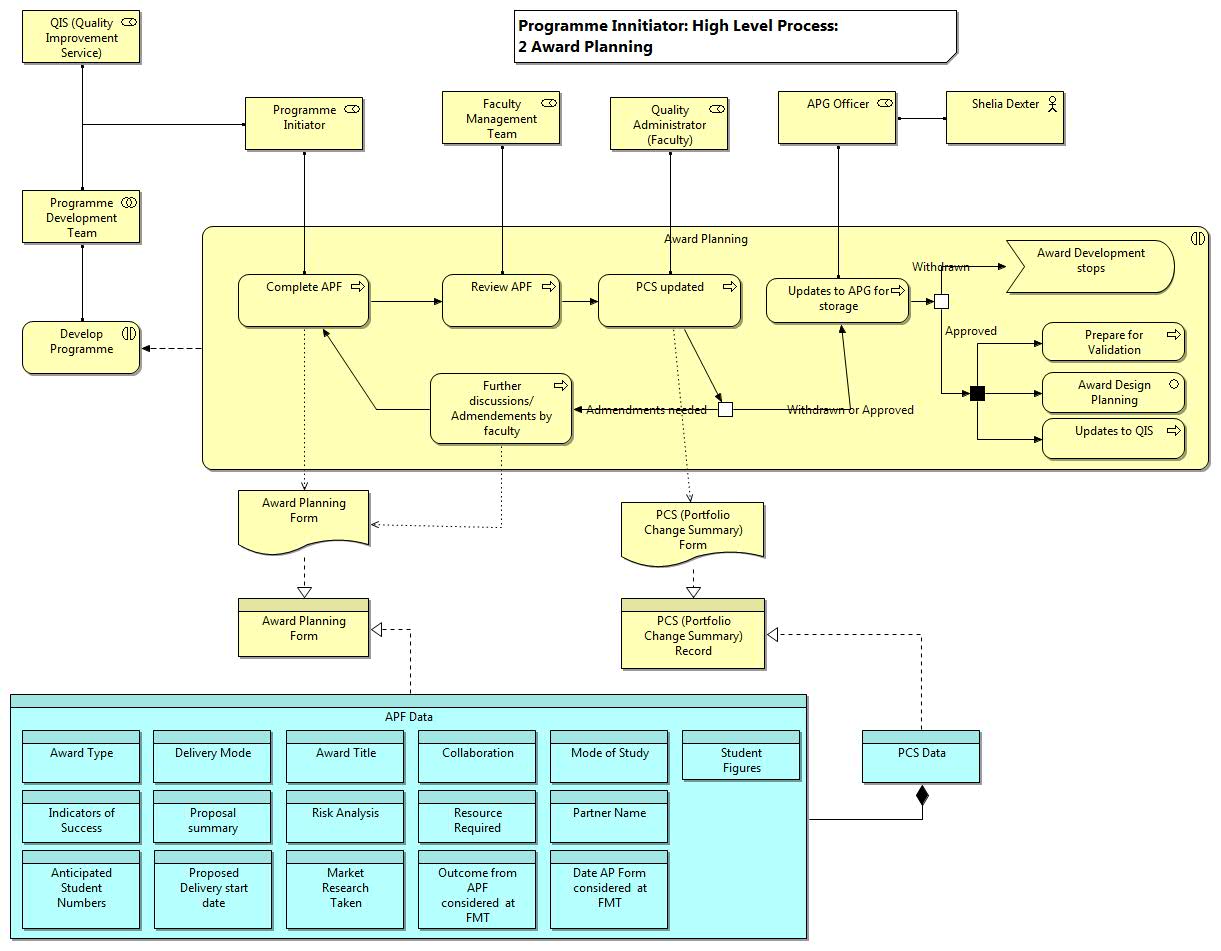 |
| ArchiMate Model of Stage 2 - Award Planning (high level) |
- What is believed to happen by managers often isn't the case for those on the ground
- Processes that are believed to be sequential are often running in tandem to ensure speed in development (can cause problems)
- Responsibility of the process of new product development can sit with different individuals without any joining up.
The first attempt at creating a work-flow from idea to validation is shown below - all information in black is considered part of the core/ parent process, the text in red is information that sits within child processes (Completing documentation, Understanding Employer Engagement, Assessment etc).

This helped clarify my thoughts before moving on to using Word as a standard tool to create the workflows, with the relevant advice attached to the different preparation points. At first each point in the core work-flow became a new stage in the process, however we soon changed that to match the stages from modelling.
- Idea
- Initial Approval
- Award Approval Documentation
- Preparing for Validation
- Validation
 |
| Flow and Advice v1 for Stage 3 - Preparing for Validation |
These models have since been distributed to the project team to help create the child processes, as they are more familiar with that area. This was one of the reasons I chose to use Word to create the flows, so that they could copy the standardisations easily. Even so it has required a short demo document so that the flow fits the set up of Pineapple, including a two page document where on one side was the actual flow in Pineapple using screen shots and on the other was the actual flow created. As I am very close to this work it has been invaluable to hand it over to the project team for review and also over to faculties already interviewed. It has also been vital that I keep impartial to the work so that I can view all aspects of the suggestions made. I also believe it has helped that I am not a process owner in creating these flows. It has been demonstrated by some of the work already gone on that process owners have a very narrow view of curriculum design and development!
These workflows have been designed to be printed out and used for each stakeholder discussion to ensure we captured each faculties nuances around course development before building the process into Pineapple.
Monday, 31 January 2011
We make it so hard
Thank you Mark for the welcome back!
As Mark said in the last Enable Blog, the Enable methodologies are being successfully embedded into relevant plans and strategies, and more importantly the message that we need to think about our information as a whole and separate to our systems is becoming widely accepted within the university and we are hearing it repeated at different committees, and was widely accepted at our SMWG meeting.
The SWMG meeting on Friday, left us feeling very positive about what we have already done and the way we can move forward. We spoke about the recognised opportunities that adopting Enterprise Architecture & Programme Management would give the university, and that the lead for this needed to come from Executive. More importantly Executive recognised the need for them to be able to lead it and have gone away with a number of papers, with actions, to consider. We look forward to what takes place over the next few months.
Rather interesting it was clear that discussions around how the university needs to have a corporate view of university systems/ information/ processes, and how we manage them had taken place in other meeting where it had been deemed "to hard", and that it was easier to focus on changing small issues without recognising the projects longer term impact. We discussed that we make things hard for ourselves - by repeating the same mistakes the job becomes harder. We need to understand is using EA / TOGAF too hard? Or is it simply a matter of understanding that it's a job that needs doing, requires time and (the right) staff to enable it to happen (with the right governance)? Once this understanding has taken place and actions taken surely it is simply a matter of time and effort rather than any sort of brain surgery/rocket science? We shall see!
Another useful message we managed to communicate during the SMWG meeting was that stakeholder engagement was vital to successful engagement in managing change and the curriculum development - and this doesn't simply mean engaging in committees. It means talking to people and, importantly listening with out judging/ justifying.
Lastly we were able to successfully demonstrate the two mini projects External Examiners and TransAPEL - but we were very clear that Enable used these two mini projects as proof of concept and was not something the Enable team should be doing day to day. We need to focus on the wider aspects of Curriculum Design and Development, and help the university make good choices in the future about project work and developing its business processes etc. We need to be able to advise the Executive but not be those who implement it. It will be interesting to see how our developments are (if successfully piloted) will be embedded into the university processes. Watch here over the next few months as both systems enter a piloting phase.
Edit (07/02/2011)
Our Presentation (with sound) to the SMWG
Wednesday, 30 June 2010


Wednesday, 23 June 2010
Sustaining Innovation and Enterprise Architecture
The last month has been quiet, mainly due to holidays and attending workshops that have resulted in giving me long to do lists! The month started with a workshop here at Staffordshire University, Sustaining Innovation via Organisational Development Workshop. This was a great day that resulted in some useful discussion around how we engage Senior Management in supporting innovation and embedding it into the day to day. We had guest speakers from Australia, Manchester and Plymouth (among others). I tweeted heavily on the event (and others I have attended) and to read them and others on Enable check out Twapper Keeper http://twapperkeeper.com/hashtag/jiscenable. Useful thoughts from the day included
- Mark Stubbs rethinking what we do with the curriculum. Asking fundamental questions, why is approval process face to face?
- interesting question from @markstiles about institutional values and data: secretive? open? risk-taker? risk-averse?
- Enterprise Architecture as a model for managing innovation but role of effective governance also critical
- USQ's Australian Digital Futures Institute - yes please! Can we have one?
- Strategy & structure need to be scrutinised & regularly realigned
After this event it was back to interviewing faculties about their involvement in working with External Examiners. We have learnt a lot with these interviews and discovered extra stakeholders involved that had not been considered during the review. We are now planning an extra round of interviews to get them engaged. The best way we have done this is with three of us attending each meeting, one specialist from QIS, our Technical Manager to roughly bring together a model as we talk and me, to make a narrative note of the processes and issues faced by stakeholders. This seems to work well with each of our different perspectives opening up more questions about what is happening in faculties at the moment and what they would like to see happen. Everyone (so far) has been pleased that something is happening to support the work taken in this area.
This week I have attended the Enterprise Architecture Workshop in Birmingham. A useful blog post has been written on this by John Townslend (http://jwt23.wordpress.com/2010/06/21/jisc-enterprise-architecture-practice-group-workshop-june-21st-ea-impact/), who usefully has blogged about the management stream that ran at the same time as the practitioner session I attended. The hands on session was very useful, with discussions about whether there is a right way to model, with a practical example that we could model using Archi (http://archi.cetis.ac.uk/) I was able to use this time to talk to our technical manager about my first attempt at modelling for one of our SURF colleges, which resulted in me re-modelling more explicitly and getting me up early on the second day to continue working on it before the sessions. You can certainly find yourself losing hours to working on models if you're not careful! The second day focused on the future of the group, what did we want over the next year, where did we want it held and did we see a future for the group to become a professional practitioners group as it grows in experience and numbers. There was also discussion around supporting the development of a foundation programme to support those who are just entering the EA arena, there were a lot of takers for the programme, including wanting to get Senior Management to get engaged with the programme so that they understood terms etc used by staff - although not have them attend the full 4 days. At the moment I am preparing for next weeks visit to Flordia for the EISTA 2010 conference where I am talking about managing strategic change in HE. I will let you know how that goes!
Tuesday, 27 April 2010
Working together
This week has me reading a number of blogs from our partner colleges, this has made for some interesting reading. Mainly they pick up on the same issues that we have already noted but every now and again a real gem of an issue appears, two examples include:
We are also starting work on the "mini project" which is our pilot on testing not simply technology solutions to issues around External Examiners but Programme Management and Enterprise Architecture also get in on the deal. We have our first set of interviews around this work at the start of May, before that our Technical Manager is sorting out the technical issues around this "mini project".
The end of this week we have a cluster meeting in Bolton which will be very interesting, this will be a one day event with a focus on the use of technology to support CDD - including what I am hoping will be useful discussions and demonstrations around using Wookies, Widgets and using XCRI. I am sure this will result in another blog post!
- If validation can't occur before Sept 2010 college is looking at having to wait a year to deliver - is this because of the university? because the college doesn't like "mid" year starts, or don't the learners?
- Awards are running but access to the VLE across partners is difficult or can be delayed by a year - again why?
We are also starting work on the "mini project" which is our pilot on testing not simply technology solutions to issues around External Examiners but Programme Management and Enterprise Architecture also get in on the deal. We have our first set of interviews around this work at the start of May, before that our Technical Manager is sorting out the technical issues around this "mini project".
The end of this week we have a cluster meeting in Bolton which will be very interesting, this will be a one day event with a focus on the use of technology to support CDD - including what I am hoping will be useful discussions and demonstrations around using Wookies, Widgets and using XCRI. I am sure this will result in another blog post!
Subscribe to:
Posts (Atom)

 Posts

